|
SPOTLIGHT ON TAIWAN
Endemic subspecies of Taiwan birds— first impressions
N. J. COLLAR
Taiwan possesses 15 endemic bird species that every birder wants to
get during the course of a visit. These are (in order of their
scientific description, with date provided) Taiwan Whistling Thrush
Myophonus insularis
(1862), Swinhoe’s Pheasant
Lophura swinhoii
(1863), Taiwan Blue Magpie
Urocissa caerulea
(1863), Taiwan Partridge
Arborophila crudigularis
(1864), White-eared Sibia
Heterophasia auricularis
(1864), Steere’s or Taiwan Liocichla
Liocichla steerii
(1877), Styan’s or Taiwan Bulbul
Pycnonotus taivanus
(1893), Yellow or Taiwan Tit
Parus holsti
(1894), Mikado Pheasant
Syrmaticus mikado
(1906), Collared Bush Robin
Tarsiger johnstoniae
(1906), Flamecrest
Regulus goodfellowi
(1906), Whitewhiskered Laughingthrush
Garrulax morrisonianus
(1906), Taiwan Barwing
Actinodura morrisoniana
(1906), Taiwan Yuhina
Yuhina brunneiceps
(1906) and Taiwan Bush Warbler
Bradypterus alishanensis
(2000). You can fairly well gauge the elevations at which these
things occur—and hence the order in which they are likely to be
ticked off— by the dates of their description, starting with Robert
Swinhoe’s multiple gleanings from the lowlands in the 1860s (his
pheasant must have been a captive bird brought to him) and ending
(almost) with the climactic six-species achievement of Walter
Goodfellow forty years later as he reached the summit of Yu Shan,
then Mt Morrison (see Ogilvie-Grant 1906). Most of these species are
extremely distinctive, although none is in its own genus (the Yellow
Tit has its own subgenus
Machlolophus);
only the whistling thrush, Flamecrest, bulbul and bush warbler
appear to be very close to mainland Chinese forms. But does the
taxonomic distinctiveness of Taiwan end with these species? Taiwan
possesses a good many endemic subspecies as well, but how
distinctive are they? Which among them might be eligible for
upgrading to species level in the event of a new taxonomic revision?
While it is always difficult to fix a complete inventory, owing to
different judgements about the validity of many taxa and the extent
to which they figure in modern treatments, a very preliminary review
of the island’s endemic subspecies (78 in this compilation —all, I
hope, of those currently or recently claimed) is attempted here,
based on a list originally compiled by Brian Sykes and a three-day
review of material at the Natural History Museum (NHM) in Tring,
U.K. In this short exploratory survey, I treat each of these taxa in
turn. I have sought for and, where found, provided diagnostic
characterisation of each subspecies from the standard or original
sources, and deal very briefly with various types of uncertainty
associated with particular taxa. Where a subspecies is said to be
“undescribed” by a source, this still means that the source
recognises it as valid. The first paragraph of the entry accounts
for the foregoing information. The second mainly provides a
commentary based on my examination of specimens at NHM. Each taxon
is marked with a symbol to indicate my tentative reckoning: ** =
possible full species; * = strong (clearly marked) subspecies; • =
weak (poorly marked) subspecies; † = dubious subspecies; ‡ =
subspecies but not endemic; – = no decision possible. I use
“eyeballing” to mean just a brief visual comparison, including
matching wing and tail lengths against each other. To save space,
Handbook of the birds of the world
is indicated, with appropriate volume, as
HBW,
and I should add that as I wrote the quoted
HBW
(in press) texts for the thrushes and chats I offer no commentary on
their accuracy.
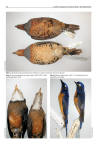 Chinese Bamboo Partridge
Bambusicola thoracicus sonorivox**
Generally darker than nominate; much smaller rufous throat-patch;
chestnut (not black) blotches on flanks (HBW
2). The differences between the two taxa are striking. In the
nominate the “rufous throat-patch” is the entire area from below the
eyes to the necksides, with a grey breast-patch below (but with the
rufous encompassing it by forming a narrow line below). In
sonorivox
the grey of the breast extends around the rufous chin and throat to
the necksides and over the eyes. The underparts of the nominate,
below the breast, are buff with small sparse blackish spotting,
almost entirely on the flanks; in
sonorivox
the underparts are rufous-buff with extensive broad chestnut
spotting and scaling (a few nominate show more extensive and broader
spotting, but not the same degree) (see Plate 1). There are further,
lesser, differences above (sonorivox
more suffused grey and olive, with more rufous-tinged crown
markings, fewer white spots on wing-coverts and mantle, reduced buff
edges to wing-coverts). Chinese Bamboo Partridge
Bambusicola thoracicus sonorivox**
Generally darker than nominate; much smaller rufous throat-patch;
chestnut (not black) blotches on flanks (HBW
2). The differences between the two taxa are striking. In the
nominate the “rufous throat-patch” is the entire area from below the
eyes to the necksides, with a grey breast-patch below (but with the
rufous encompassing it by forming a narrow line below). In
sonorivox
the grey of the breast extends around the rufous chin and throat to
the necksides and over the eyes. The underparts of the nominate,
below the breast, are buff with small sparse blackish spotting,
almost entirely on the flanks; in
sonorivox
the underparts are rufous-buff with extensive broad chestnut
spotting and scaling (a few nominate show more extensive and broader
spotting, but not the same degree) (see Plate 1). There are further,
lesser, differences above (sonorivox
more suffused grey and olive, with more rufous-tinged crown
markings, fewer white spots on wing-coverts and mantle, reduced buff
edges to wing-coverts).
Common Pheasant
Phasianus colchicus formosanus*
Undescribed in
HBW
2. Paler than E Chinese race
torquatus,
with flanks almost whitish-buff and mantle straw-coloured (Madge and
McGowan 2002). The differences between
formosanus
and
torquatus
are as stated, the former also having a green-based rather than
blue-based rump, but the two are extremely similar.
Barred Buttonquail
Turnix suscitator rostratus
• Undescribed in
HBW
3 and Johnsgard (1991), although the latter indicates “a duller
non-breeding plumage also exists in some races (rostrata
[sic],
blakistoni)”.
The NHM material, which is diversely labelled, suggests that Taiwan
females are slightly more rufous-tinged below and slightly buffier
in the wing-coverts and the males have reduced barring on the throat
and flanks, but the effects of age and season may be in play. At any
rate,
rostratus
appears to be a poorly marked subspecies.
Grey-capped Pygmy Woodpecker
Dendrocopos canicapillus kaleensis
• Treated by Short (1982)—and hence by Winkler
et al.
(1995) and
HBW
7—as encompassing several mainland taxa, but Dickinson (2003)
followed Cheng (1987) in retaining
kaleensis
as referring exclusively to Taiwanese birds. Short (1982) admitted
that Taiwanese and Vietnamese birds are smaller than the others in
this group, implying that the former has a longer tail. Otherwise
there is no published comparative description. La Touche (1931
[=1931-1934]) separated the adjacent mainland form (nagamichii,
although he first used
kurodae)
from more northerly
scintilliceps
for having less white on back and wings, less white on upper back
(and barred with black), wing-spots smaller, underparts richer and
buffier and more broadly streaked, with underwing-coverts always
marked with black and sometimes broadly barred; and from
kaleensis
as “very similar… but larger”. La Touche’s diagnosis of
nagamichii
from
scintilliceps
holds. However, eyeballing five males from Taiwan and from the
adjacent mainland I cannot see a convincing size difference,
although some Taiwan birds may be shorter-tailed. Clearly the two
populations are so similar that taxonomic separation is
questionable. However, mainland birds (including females)
consistently show larger white markings on the tertials, and on this
basis I tentatively accept
kaleensis
as endemic to Taiwan.
White-backed Woodpecker
Dendrocopos leucotos insularis
• Smallest race, similar to
D. l. tangi
but more white on back, more extensive pink below (HBW
7). NHM specimens are decidedly shorter-winged and shorter-tailed
than
tangi,
but they have neither more white on the back nor more pink on the
underparts.
Grey-headed Woodpecker
Picus canus tancolo
• Treated by Short (1982)—hence by Winkler
et al.
1995),
HBW
7 and Dickinson (2003)—as encompassing the population on Hainan, but
Cheng 1987) continued to recognise
hainanus
from the latter. Given how improbable it is for the same subspecies
to occur on two widely separated islands, especially when there are
adjacent, essentially intervening mainland populations, Cheng’s
treatment seems appropriate, although Short’s only diagnosis is that
“Hainan birds average slightly smaller than those from Formosa, but
there is great overlap”. Taiwan birds are clearly smaller than those
on the adjacent mainland. Hainan birds are less clearly smaller than
Taiwan birds. The separation of the latter goes back to Stuart Baker
(1919), who commented: “There are only two specimens of Hainan birds
in the British Museum, but these are smaller than Formosan birds,
with smaller bills, and are possibly also rather darker above and
less brown below. It is with some doubt that I keep them separate,
but Dr Hartert, who formerly considered the two subspecies identical
(Novitates
Zool.
xvii p.222), informs me that a series of 12 birds in the Tring
Museum [these will now be in New York, where Short will have seen
them] bears out the above characters…”. Both Hainan birds (a male
and female) have blacker-streaked crowns than any of the six from
Taiwan and than most of those from the adjacent mainland. They are
infinitesimally darker green above than Taiwan birds but similar
below. The slight size difference appears to be real (a larger
sample of both taxa is needed to confirm or refute Short’s “great
overlap”). However, on these tenuous distinctions I accept
hainanus,
making
tancolo
endemic to Taiwan.
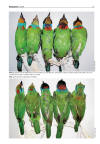 Black-browed Barbet
Megalaima oorti nuchalis**
Intermediate (with
M. o. annamensis)
between nominate race and black-crowned races
sini
and
faber,
nuchalis
with red on mantle (HBW
7). Although
nuchalis
can be thought of as intermediate in the way
HBW
suggests, it is in fact less so morphologically than at first
glance, and not at all so in terms of geography. Races
oorti
and
annamensis
from SE Asia clearly belong together rather than
annamensis
with
nuchalis),
differing
in distinct but small ways; the same is true of
faber
and
sini,
which are approximately adjacent in S China. The Taiwan taxon shares
the full red breast-patch with the latter pair, and the crown colour
with the former pair, but both former and latter are more similar in
having red on the hindcrown, whereas
nuchalis
has a red stain on the mantle (not the nape, despite its scientific
name). My inclination would be to treat
oorti
and
annamensis
as one species,
faber
and
sini
as a second, and
nuchalis
as a third. See Plates 2 & 3. Black-browed Barbet
Megalaima oorti nuchalis**
Intermediate (with
M. o. annamensis)
between nominate race and black-crowned races
sini
and
faber,
nuchalis
with red on mantle (HBW
7). Although
nuchalis
can be thought of as intermediate in the way
HBW
suggests, it is in fact less so morphologically than at first
glance, and not at all so in terms of geography. Races
oorti
and
annamensis
from SE Asia clearly belong together rather than
annamensis
with
nuchalis),
differing
in distinct but small ways; the same is true of
faber
and
sini,
which are approximately adjacent in S China. The Taiwan taxon shares
the full red breast-patch with the latter pair, and the crown colour
with the former pair, but both former and latter are more similar in
having red on the hindcrown, whereas
nuchalis
has a red stain on the mantle (not the nape, despite its scientific
name). My inclination would be to treat
oorti
and
annamensis
as one species,
faber
and
sini
as a second, and
nuchalis
as a third. See Plates 2 & 3.
House Swift
Apus nipalensis kuntzi
or
A. affinis kuntzi
–
Intermediate between nominate (i.e.
nipalensis)
and
subfurcatus,
with most heavily streaked rump of any subspecies (HBW
5; also Chantler 2000). This is all based on Brooke (1971):
“intermediate in general colour between
nipalensis
and
subfurcatus,
but has the rump ashy white and usually with dark shaft-streaks, not
clear white as in all other races”. The original description (Deignan
1958) also mentions “general coloration… almost matt black” with a
hint of greenish not bluish gloss, and the greyish-white of throat
making the definition of light and dark areas less clear. There
appear to be no specimens in NHM, but one bird (1914.4.8.13), simply
marked “Takao” and taken by Styan, must be from Taiwan (Styan
collected there, Swinhoe lived and took birds in "Takow" (see, e.g.,
Swinhoe 1865), and a 1922
Times atlas
marks Takao on the site of modernday Kaohsiung and indicates no
place of the same or similar spelling for anywhere in China). This
does not possess a rump any more heavily streaked, ashier or less
clear-cut than specimens taken at random from NHM trays for
nipalensis
and
subfurcatus
(latter from the adjacent mainland). Why in any case would a
geographical outlier be intermediate between two subspecies that lie
to the west and far south-west of it? Of course a sample size of one
with a question-mark over its provenance is not the basis of a
taxonomic judgement, and I think the distinguished authorities above
should be allowed to prevail; but a new look at the evidence would
be worthwhile.
Grass Owl
Tyto capensis pithecops
(Eastern Grass Owl
T. longimembris pithecops)
• Treated as synonymous with
chinensis
by König
et al.
(1999). Larger (than [nominate] race
longimembris
or else race
chinensis)
with some buff suffusion (HBW
5). Four specimens of
pithecops
in NHM are not obviously larger than the five of
chinensis;
however, all are whiter-faced, and three are distinctly paler buff
on the breast, whiter on the lower abdomen, and paler on the
uppertail (the fourth is matched in these features by one relatively
pale
chinensis).
On this slim basis
pithecops
seems valid.
Mountain Scops Owl
Otus spilocephalus hambroecki*
Has no rufous morph; dark brown above with prominent pale collar,
buffish and finely streaked below, with very distinct pale facial
disc and long bicoloured ear-tufts (HBW
5). König
et al.
(1999) suggest its voice is typical of the species. NHM specimens
are as indicated, and marginally less rufous-tinged below and above.
Facial pattern, long ear-tufts and whitish nuchal collar make this a
very distinctive form (albeit
vanderwateri
from Sumatra possesses the same collar pattern).
Elegant Scops Owl
Otus elegans botelensis
–
Darker and even more finely marked than Japanese birds, often
occurring in dark rufescent morph (HBW
5). NHM has no
botelensis.
Collared Scops Owl
Otus bakkamoena glabripes
or
O. lettia glabripes
• Paler than nominate (lettia)
(HBW
5); toes bare (König
et al.
1999). Compared to adjacent mainland race
erythrocampe
(name not used in NHM),
glabripes
is not discernibly paler. However,
erythrocampe
has a ruff of feathers bordering the lower facial disc which are
largely buff and distinct from the stonewhite in the rest of the
underparts and face, whereas in
glabripes
this area is stone-white; moreover, there is more buff in the
upperparts on
erythrocampe
than in
glabripes,
and the latter’s toes are indeed less feathered basally. This
therefore seems a moderately distinct subspecies.
Brown Wood Owl
Strix leptogrammica caligata
or
S.newarensis caligata
†
This taxon is universally treated as present on both Taiwan and
Hainan (Cheng 1987,
HBW
5, König
et al.
1999, Dickinson 2003) but, given the presence of populations
(allocated to
ticehursti)
all along the intervening Chinese mainland, the logic and likelihood
of this arrangement are questionable. König
et al.
say “slightly larger than nominate… possibly a synonym of nominate”.
NHM has two specimens from Taiwan (one female, one unsexed), none
from Hainan. Wing and tail lengths, eyeballed, do not differ from
three (all male) mainland Chinese specimens (race
ticehursti).
The underpart barring on the two Taiwan specimens is slightly vaguer
and browner than that on mainland birds, but this may be a sex, age
or individual difference; a female
ticehursti
from Vietnam appears identical to the Taiwan birds. On this
inadequate sample and review, I am inclined to regard
caligata
as invalid.
Tawny Owl
Strix aluco yamadae
• Undescribed in both
HBW
5 and König
et al.
(1999). Yamashina (1936) diagnosed
yamadae
as similar to
nivicola
(the race from adjacent China) but “decidedly smaller”, with minimal
overlap in wing length of eight specimens (256-282
vs
282- 312 mm). Eyeballing wing length of the only
yamadae
in NHM against the single race
ma
and a large series of
nivicola
(split as Himalayan Wood Owl in Rasmussen and Anderson in press)
suggests that Yamashina was correct, and I find that Mees (1970)
also had a specimen that confirmed the diagnosis.
Collared Owlet
Glaucidium brodiei pardalotum*
Darkest race (HBW
5). König
et al.
(1999) acknowledged no other race except
pardalotum,
but their description involves no comparison. Specimens in NHM are
not noticeably darker than mainland Chinese birds, but the streaks
on the lower underparts are darker and more distinct, and the head
is all spotted, not (mainly) barred and (slightly) spotted. The pale
markings on the upperparts of most
pardalotum
are buffier than in mainland birds. It would be worth checking how
different the voice of Taiwan birds is, but on this evidence
pardalotum
is a good subspecies.
Savanna Nightjar
Caprimulgus affinis stictomus
• This taxon breeds in Taiwan and may or may not winter in Indochina
(Cleere 1998, Holyoak 2001), but does not breed in the latter as
implied in Dickinson (2003). Cheng (1987) and
HBW
5 list it for Taiwan only. Placed in
monticolus
group by Cleere, and considered in the past to be synonymous with
monticolus,
but the five specimens in NHM are greyer overall (Holyoak 2001).
Cleere noted that the type, a female, is buffish-brown above and
cinnamon-tinged below, and that two male specimens are also very
buffish. Swinhoe (1866) thought Taiwan birds extremely close to
monticolus
and only gave them a name because Blyth, having seen a female
specimen, encouraged him to do so. The five NHM specimens of
stictomus
are indeed less rufous both above and below than specimens of race
amoyensis
from adjacent mainland China.
Oriental Turtle Dove
Streptopelia orientalis orii
†
Duller than nominate (HBW
4). Very similar to nominate but underparts average slightly paler;
probably not valid, but sample size too small (Gibbs
et al.
2001). Yamashina (1932) based his description on its smaller size,
and “many specimens… somewhat paler in colour than
S. o. orientalis…
breasts more purplish-red and… rump… more greyish-blue”. NHM holds
five specimens from Taiwan. Three are relatively paler-bellied than
apparently comparable material from mainland areas and Japan, but I
cannot see any reliable way of distinguishing these birds—their wing
lengths match those of Japanese birds—and
orii
seems best placed in synonymy with
orientalis.
Spotted Dove
Streptopelia chinensis formosa
†
This race was not mentioned by
HBW
4 and was rejected by Gibbs
et al.
(2001), followed by Dickinson (2003), but Cheng (1987) admitted it,
and Gibbs
et al.
acknowledged its minor differences (“may average a little larger and
have more white on the outerwebs of the outer tail feathers”). In
describing it, Kuroda (1927) regarded it as identical in plumage and
merely shorter-winged on average. Eyeballing three Taiwan specimens
in NHM (which does not recognise the taxon) against birds from
mainland China, many of the latter have comparable wing lengths and
none shows more white on the outertail; so
formosa
seems a likely synonym of
chinensis.
Emerald Dove
Chalcophaps indica formosanus
†
This taxon was rejected by Gibbs
et al.
(2001) as one of a number of subspecies which “show no significant
differences and are best treated as synonyms of the nominate”. Even
Cheng (1987) took this line;
HBW
4 and Dickinson (2003) make no reference to the taxon. Swinhoe
(1865) diagnosed it on the basis of black, not greyish-brown
undertail- coverts. NHM has seven specimens from Taiwan, all in
essence identical to mainland birds. The undertailcoverts of
Taiwanese birds are blackish-grey, but some (collected after Swinhoe)
are ash-grey, and this feature appears variable in continental forms
also.
White-bellied Green Pigeon
Treron sieboldii sororius
• This subspecies was accepted by Cheng (1987)— who listed it as
wintering in adjacent mainland China—and hence by Dickinson (2003),
but was ignored as one of several unspecified but invalid races in
HBW
4, and explicitly rejected by Gibbs
et al.
(2001): “examination of a good series… could
confirm none of the diagnostic features nor establish any other
significant differences from the nominate”. NHM contains at least
eight females and six males from Taiwan, and a larger series from
Japan. In the Taiwan tray D. Goodwin, author of
Pigeons and doves of the world,
has left a note: “I can see no distinction between the Japanese &
Formosan specimens. The original statement (based on comparison with
a written description) of the colour differences of back & rectrices
are [sic]
incorrect”. Indeed, back and tail feathers are uniform. However,
males from Taiwan all show yellower crowns, napes and neck-sides
than any from Japan; and the females do likewise, though less
obviously. On this basis
sororius
emerges as valid, but the difference could scarcely be slighter.
Whistling Green Pigeon
Treron formosae formosae
– (**)
From two Japanese races by golden-bronze crown, smaller size,
brighter plumage; Gibbs
et al.
(2001) listed several characters of the fourth race
filipina
that do not conform with their own description of the
nominate—abdomen white, maroon extending onto mantle, iris blue not
red, bill without yellowish or greyish tip—but comment that “none of
these features seems to distinguish this form convincingly from the
nominate”. They do, however, retain
filipina,
as does
HBW
4; otherwise nominate
formosae
would not be endemic to Taiwan. Nominate
formosae
is very and fairly distinct from the northern and southern Ryukyu
races respectively, and its separation at species level may be
appropriate; this needs urgent investigation, as the conservation
status of the species, as currently constituted, is Near Threatened
(BirdLife 2001), and a split into two species would probably upgrade
both to a higher category of threat (but it is uncertain whether the
southern Ryukyu race would belong with its northern or southern
neighbour). NHM contains no
filipina.
Black-chinned Fruit Dove
Ptilinopus leclancheri taiwanus
–
Larger than nominate with a longer tail, much more massive bill,
darker green upperparts with blue blotching from crown to back,
larger, paler, more maroon breast-band, posterior of chin-patch more
maroon, underparts much darker. This description is taken from
Ripley (1962) by Gibbs
et al.
(2001), who remarked that
taiwanus
is “known from very few specimens, most of which are now lost”.
HBW
4 did not recognise it but may have missed Ripley (1962) altogether,
as they did not admit Taiwan itself in the range of the species,
merely “Lan Hsü” (presumably Lanyu). NHM holds no specimens. From
the description by Ripley, this ought to be a highly distinctive
form, and the fact that it is hardly known on Taiwan is completely
mystifying.
Slaty-breasted Rail
Gallirallus striatus taiwanus
†
Palest race, along with race
gularis
(HBW
3); as pale as race
jouyi,
but smaller; paler than
gularis,
upperparts more greyish-olive, white on belly more extensive (Taylor
1998). Yamashina (1932) distinguished it from nominate
striatus
and race
gularis
by its being “strikingly pale” above and below, with grey edges to
back feathers, grey ground colour of wings and flanks, and broader
(twice as broad) white stripes on flanks; and from
jouyi
by its smaller size. NHM only holds a small sample of the species in
general, and only two Taiwan birds. However, one of the Taiwan birds
matches most of those from the adjacent mainland (jouyi)
in wing length, and the colour shading is indeed the same; I could
find no specimens in NHM from the range of
gularis
(S China), but as Cheng (1987) did not recognise the latter the
differences are presumably vanishingly small. On NHM evidence,
Yamashina’s diagnosis only works with respect to nominate
striatus,
not
jouyi,
so the validity of
taiwanus
appears tenuous.
Slaty-legged Crake
Rallina eurizonoides formosana
–
Colour of throat purer white (HBW
3); upperparts darker than in race
amauroptera
(Taylor 1998). This latter seems to be based on Seebohm (1895), who
remarked that “compared with immature examples of
Rallina eurizonoides…
the upper parts… are much darker”. NHM only possesses the type,
which is in immature plumage; in any case the throat feathering is
matted. Its lower underparts have the moreblack, less-white barring
of Philippine populations, and its upperparts are precisely similar
dark brownish-olive. Everything hinges on the whiter throat of
formosana
than nominate
eurizonoides.
Black Kite
Milvus migrans formosanus
†
This taxon was not recognised by Cheng (1987) nor by Ferguson-Lees
and Christie (2001), but was accepted by
HBW
4, which offered no diagnosis, and by Dickinson (2003), although
both latter sources indicated that it also occurs on Hainan (in
respect of which the same considerations as for Grey-headed
Woodpecker and Brown Wood Owl apply). Ferguson-Lees and Christie
(2001) described
formosanus
as sedentary in Taiwan (not mentioning Hainan) and as “very like
lineatus
but averages smaller” (hence in their view invalid). NHM does not
possess a copy of the obscurely published original diagnosis by
Kuroda in 1920, and Kuroda (1927) merely gave the dimensions of the
type. NHM possesses six Taiwan birds and five from “Amoy” (Xiamen)
in adjacent Fujian province. In terms of plumage and eyeballed
measurements I see nothing to distinguish the Taiwan birds; I doubt
they even average smaller.
Crested Serpent Eagle
Spilornis cheela hoya*
Undescribed in
HBW
2. Size of adjacent race
ricketti;
much darker, cheeks and throat blackish, breast nearly plain, rest
of underparts clearly spotted (Ferguson-Lees and Christie 2001).
Upheld in NHM.
Crested Goshawk
Accipiter trivirgatus formosae
• Undescribed in
HBW
2. Although relatively distant from other populations, the only
distinction given is “probably averaging larger even than
indicus”
(Ferguson-Lees and Christie 2001). The original description (Mayr
1949), however, stressed this taxon’s darkness (but disclosing that
the sample size was two!): adult male “very dark, particularly
below”, immature female “very dark and heavily marked underneath”,
the tendency towards darker coloration being “noticeable also in
certain specimens from northern Burma and northern Indo-China, but
not reaching quite the extreme shown by the two Formosan birds”. NHM
possesses four Taiwan birds, two adults (male and female) and two
immatures (male and female). The adult female and immatures are no
darker above or below than various birds from elsewhere in the
range. The adult male is matched for darkness above by two males
from Thailand; however, the pale rufous-buff breast-streaks are much
browner in the Taiwan bird, and the barring on the belly is
mid-brown with paler centres. No size differences suggest
themselves. On this meagre basis
formosae
must provisionally stand.
Besra
Accipiter virgatus fuscipectus
• Undescribed in
HBW
2. Placed with mainland “affinis”
group and judged the largest race, darker and browner above
(Ferguson-Lees and Christie 2001). The original description (Mees
1970), comparing with mainland
affinis,
indicated that adult males have “breast and barring on the
underparts browner, not so rufous”, and “upperparts… brownish-grey
rather than pure grey”, while adult females are likewise slightly
browner below but greyer (less brown) above (so that viewed from
above males and females of
fuscipectus
show hardly any difference); moreover, male wings are usually >170
mm in
fuscipectus,
usually <170 mm in
affinis.
Mees (1970) borrowed four NHM Taiwan specimens for his extensive
comparisons, but in fact NHM holds no fewer than 13 specimens from
the island. His diagnosis of differences between males holds, and on
this basis
fuscipectus
is validated; but I am stumped by his assertion that females are
greyer above than female
affinis
(some specimens show a greyish gloss, including one borrowed by Mees,
but so do several
affinis),
nor can I see any difference between NHM’s two Hainan specimens
(both female) which Mees said are brown above and therefore belong
with
affinis.
In the absence of a male from Hainan it is not possible to determine
whether
fuscipectus
is present there or not; for the moment it is appropriate to assume
not (particularly given my doubts about subspeciessharing between
the two islands), leaving
fuscipectus
a poorly marked Taiwan endemic.
Long-tailed Shrike
Lanius schach formosae
†
This taxon was accepted by Cheng (1987) but not mentioned by Lefranc
(1997), Harris (2000) or Dickinson (2003). Specimens from Taiwan are
identical to certain birds from adjacent mainland China.
Eurasian Jay
Garrulus glandarius taivanus*
Placed in the “bispecularis”
group, distinguished by “blackish mottling on forehead and dusky
nasal tuft” (Madge and Burn 1993). The nasal tufts are black, not
dusky, and the mottling is really just a few streaks immediately
above the tufts. Other diagnostic features are: smaller and
smaller-billed than adjacent mainland
sinensis,
whiter on abdomen and greyer on scapulars.
Grey Treepie
Dendrocitta formosae formosae*
Placed in the eastern group which is characterised by darker, less
patterned plumage with a very white rump and shorter, wholly black
tail; nominate
formosae
fairly brown above and light below, with basal third of central tail
feathers grey (Madge and Burn 1993). Taiwan birds differ from those
on the adjacent mainland not only by the grey bases to the tail
(black on mainland) but also by the whitish-grey rump (whitish on
mainland).
Spotted Nutcracker
Nucifraga caryocatactes owstoni*
Placed in the southern group which is distinguished from the
northern group by a mid-brown body, smaller, less intense spotting
and relatively longer tail with more white in the outermost
feathers; in
owstoni
ground colour of body sooty-brown (Madge and Burn 1993). The deeper
brown body coloration in
owstoni
is confirmed, and its blacker cap; moreover, the white
mantle-streaks in the nearest Chinese population (race
macella)
are reduced in
owstoni
to a few nape-flecks, and the size of breast-spots is also greatly
reduced.
Maroon Oriole
Oriolus traillii ardens
‡
Having eight years earlier named
ardens
as a species, Swinhoe (1870) distinguished as a variant the
population he found on Hainan under the name
nigellicauda,
asserting it to be shorterwinged and longer-tailed, with black of
neck extending less far down the breast, and black “shafts” to tail
feathers. Dickinson (2003) extended the range of
nigellicauda
to N Vietnam and SE Yunnan, China. NHM has a good series from
Taiwan, with six full-plumaged males including the type of
ardens,
but only a single full-plumaged male from Hainan, the type of
nigellicauda.
It also has a good series from Indochina. I cannot see any
difference between adult males from Taiwan and from Indochina; and I
think the sooty-shaded vanes (not shafts) of the type of
nigellicauda
are an individual variation (birds of all populations show this in
varying degree). Females and immatures from all three areas also
appear similar. Measurement of all specimens might disclose some
consistent differences of the kind to which Swinhoe alluded, but
eyeballing wings and tails suggests no real discontinuities. I
suspect the name
ardens
should apply to all these populations.
Black Drongo
Dicrurus macrocercus harterti
• Stuart Baker (1918) described this taxon as the biggest of all in
the species, with the exception of Himalayan birds (race
albirictus),
but “separable at a glance by its curiously short tail”. Stuart
Baker’s diagnosis seems to hold in NHM birds, although some
specimens have tails that are comparable in length to those of other
taxa. The geographically closest race,
cathoecus
of E China, is certainly often as long-tailed and, from Stuart
Baker’s own data, entirely overlaps
harterti
in wing length; but the bill of
harterti
appears consistently larger (deeper), and it is more on this basis
than any other that
harterti
seems valid.
Bronzed Drongo
Dicrurus aeneus braunianus*
Dickinson (2003) admitted two other subspecies, of which the closest
to approach Taiwan is the nominate, ranging from India through
Indochina to S China. Swinhoe (1863) compared his specimens of
braunianus
with specimens from India, and noted that the bill is always shorter
and broader-based, with higher feathers on the culmen, while the
head and back feathers are shorter and rounder, reflecting purple
and blue instead of copper-green; breastsheen similar, but feathers
there much larger and round instead of lanceolate; wings and tail
black below (not brown), and wings longer; feathers of tail much
broader, sheen again blue not green. Although NHM lacks material
from adjacent mainland China, many specimens of nominate
aeneus
from Indochina are available. Comparison of these with
braunianus
bears out Swinhoe’s diagnosis well, with the exception of bill
dimensions and shade of undersides of wings and tail.
Black-naped Monarch
Hypothymis azurea oberholseri
• Stresemann (1913) diagnosed this taxon as very like nominate
azurea
in colour but on average larger with slightly less violet on the
back and generally larger nape-mark. He added that the adjacent
mainland race
styani
is on average smaller, and the white of the undersides reaches
higher on the belly. At a glance I cannot see any obvious difference
in back colour between
oberholseri
and
azurea,
or in the extent of white on the belly between
oberholseri
and
styani;
however, the black nape-mark is indeed generally larger in
oberholseri
than
azurea,
and both
azurea
and
styani
appear smaller. The bill of
oberholseri
looks stouter than in
azurea,
shorter than in
styani.
Island Thrush
Turdus poliocephalus niveiceps**
Possibly best candidate for species status among at least 51
subspecies of Island Thrush, being highly distinctive in plumage,
the only subspecies with pronounced sexual dimorphism, and much the
most northerly outlier; male white-hooded with blackish upperparts
and breast-band shading to orange belly with broad black-and-whitestriped
vent, female similar but browner above, head brown with buff
postocular supercilium, buff-speckled cheeks, buff submoustachial
and throat with dark-stippled malar and throat-streaks; only in this
race does female show complex facial pattern and dark throat-streaks
(HBW
in press). I am not in favour of a major splitting exercise on
poliocephalus,
but re-checking NHM material certainly reinvigorates my sense that
this taxon may be a special case within the
poliocephalus
complex. See Plate 4.
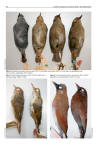 White-browed Shortwing
Brachypteryx montana goodfellowi**
Race
goodfellowi
rather different from others in plumage, bill morphology (much
longer than other races) and voice, and conceivably a separate
species; male olive-brown above, slightly rustier on forehead and
rump, with long concealable white supercilium, paler below and
whitish on mid-belly, bill black, legs brown, female similar but
with a slightly weaker supercilium (HBW
in press). The song is untypical (OBC
Bull.
30: 60). Shortwings may be to Asia a little of what tapaculos
Rhinocryptidae are to South America: possibly a complex of species
hides behind the considerable morphological uniformity that has led
systematists to unite so many taxa under this one species. The
long-billed, female-plumaged
goodfellowi
is among the most distinct of current subspecies, and certainly
warrants detailed analysis, involving close vocal comparisons, to
determine its most appropriate future treatment. See Plate 5. White-browed Shortwing
Brachypteryx montana goodfellowi**
Race
goodfellowi
rather different from others in plumage, bill morphology (much
longer than other races) and voice, and conceivably a separate
species; male olive-brown above, slightly rustier on forehead and
rump, with long concealable white supercilium, paler below and
whitish on mid-belly, bill black, legs brown, female similar but
with a slightly weaker supercilium (HBW
in press). The song is untypical (OBC
Bull.
30: 60). Shortwings may be to Asia a little of what tapaculos
Rhinocryptidae are to South America: possibly a complex of species
hides behind the considerable morphological uniformity that has led
systematists to unite so many taxa under this one species. The
long-billed, female-plumaged
goodfellowi
is among the most distinct of current subspecies, and certainly
warrants detailed analysis, involving close vocal comparisons, to
determine its most appropriate future treatment. See Plate 5.
Snowy-browed Flycatcher
Fidecula hyperythra innexa
–
There is no useful published diagnosis that I have been able to
find. Eyeballing specimens in NHM is inconclusive; they are too few
(none from SC China, apparently the nearest mainland area for the
species) and too dishevelled to make quick progress with. I cannot
see any obvious differences with nominate birds from the Himalayas.
Sharpe (1879) put it in synonymy with
hyperythra.
Vivid Niltava
Niltava vivida vivida*
Salvadori (1887) separated the race
oatesi,
which came to encompass all continental forms, on the simple
diagnosis that it is larger than
vivida,
which was first named by Swinhoe from Taiwan. The size discontinuity
is striking, although there seem to be no plumage differences (or
none obvious on a cursory glance). It would be interesting to
compare voices. See Plate 6.
White-browed Bush Robin
Tarsiger indicus formosanus*
The distinctive isolated form
formosanus
clearly represents an offshoot of
indicus
but might better be treated as a separate species, particularly if
vocally different, but it has been judged to hybridise with Collared
Bush-robin
T. johnstoniae,
which complicates any taxonomic assessment; male like male nominate
above but with ochreisholive crown diffusing onto mantle, little or
no white malar, and pale olive in place of dull orange, but female
like female nominate (and only told from female Collared by
olive-buff vent) (HBW
in press). Hartert (1909) found
formosanus
slightly smaller in wing and tail, with slightly different wing
shape and formula. The colour of the male underparts is basically
feminised (as with the island’s White-browed Shortwing), and other
differences are trivial. I favour retention as a subspecies.
Plumbeous Water Redstart
Rhyacornis fuliginosus affinis
• Female duller grey above, more narrowly barred below, with
slightly less white on rump and tail (HBW
in press). Ogilvie-Grant (1906) indicated the male has less black
lores and dusky ends to the tail. These characters are all very
minor.
White-tailed Robin
Myiomela leucura montium
• Very slightly smaller than nominate, and female with more
olive-toned, less buffy-brown breast (HBW
in press). Swinhoe (1864) knew it was close to what is now nominate
leucura,
but stated it lacks “the blue eye-streak and has a shorter and
differently marked white and black tail”. The NHM sample is now
larger than the material available to Swinhoe, and it is clear that
only the slightly shorter tail still stands as a character. A note
in the
montium
tray by D. Goodwin expresses doubt about its separability, although
on average smaller; he gave average wing and tail lengths of 10
males each of 93 mm and 69 mm (montium)
vs
96 and 74 mm (nominate). The
HBW
diagnosis of female breast pattern is a previously unremarked
character.
Little Forktail
Enicurus scouleri fortis
†
This taxon was rejected by Vaurie (1955) and Cheng (1987), and hence
Dickinson (2003).
HBW
(in press) also discounts it but notes populations on Taiwan average
slightly larger and possess a slightly more extensive white
forecrown. Hartert (1910a), in describing it, said it was larger,
with a longer bill, but he thought southern Chinese birds belonged
with it also. In the NHM
fortis
tray is a note by D. Goodwin: “Our Formosan specimens are… just
separable from topotypical
E. s. scouleri
by their more intense glossy black colour & larger white forehead
patch, tho’ not on size, which overlaps. Birds from China are
intermediate, some match Punjab & some Formosan specimens”. The
evidence tends to suggest that “fortis”
is the end of a very minor cline and unworthy of recognition.
Crested Myna
Acridotheres cristatellus formosanus
†
From other races by having frontal crest more developed, and larger
(Hartert 1912). Slightly smaller with a greenish-yellow bill, slight
green tinge on crown and back, and white undertailcoverts (Hachisuka
and Udagawa 1950[-1951], cited by Feare and Craig (1998). Hartert
thought
formosanus
larger, Hachisuka and Udagawa smaller. My own eyeballing comparisons
suggest there is great overlap. Frontal crests of some mainland
Chinese birds are at least as well developed as those from Taiwan.
Mainland birds also have greenish-yellow bills, the green crown
tinge and white-tipped undertail-coverts (if anything the white tips
on Taiwan birds are smaller). On this evidence I am unpersuaded.
Winter Wren
Troglodytes troglodytes taivanus
• Greyer and less rufous than races on islands immediately to the
north (Brewer 2001). Hartert (1910a) diagnosed it as like eastern
Siberian birds but with paler, less reddish upperparts, uniform,
rather yellowish-brown throat, and neck-sides without whitish
flecks. NHM specimens are extremely close to adjacent mainland
birds, but the plainer (less patterned) breast is apparent.
Coal Tit
Parus ater ptilosus
• Placed in group with SE China race
kuatunensis
and differentiated by longer crest, slightly darker upperparts and
less buff underparts (Harrap 1996). In the small NHM sample I can
only confirm the slightly longer crest; even this is a very small
distinction, while the others are too subtle for my eye.
Green-backed Tit
Parus monticolus insperatus
• Like widespread race
yunnanensis
but tertials, secondaries and greater and median coverts with
broader white tips, and blue, not white, fringes to tertials (Harrap
1996). Upheld in NHM.
Varied Tit
Parus varius castaneoventris*
Like races
amamii
and
olivaceus,
with underparts uniform dark rufous with no pale median line and
much reduced chestnut border to upper mantle, but no olive tone to
mantle and averages rather smaller (Harrap 1996). [Population in
Guangdong, S China, either this or an undescribed race, probably
latter (Harrap 1996).] NHM possesses no
amamii
(Amami, Tokunoshima and Okinawa) or
olivaceus
(Iriomote) to follow the above comparison, but
castaneoventris
is deeper chestnut below and
tiny
by comparison with other races in NHM; given wing 75-77 in
amamii,
65.5–66.5 in
olivaceus
and 60-64 in
castaneoventris
(Harrap 1996), size alone validates the Taiwanese subspecies.
Collared Finchbill
Spizixos semitorques cinereicapillus*
Like nominate, but “dark parts of the head grey instead of black” (Swinhoe
1871). The crown in NHM material is grey (cinereicapillus)
vs
very dark grey (semitorques);
the white breast-band appears slightly narrower, and the tail
decidedly shorter in Taiwan birds.
Light-vented or Chinese Bulbul
Pycnonotus sinensis formosae
• From nominate by whiter underparts (fainter and fewer yellow
lines), darker grey breast-band, slightly greyer back and sometimes
shorter wings (Hartert 1910b). Upheld in NHM, but the differences
are minor.
Black Bulbul
Hypsipetes leucocephalus nigerrimus*
Black, with grey edges to primaries and tail feathers (Gould 1862).
Upheld in NHM—the only subspecies in this variable species to
combine the characters above.
Brown-eared Bulbul
Ixos
[Microscelis]
amaurotis harterti
–
Very similar to race
stejnegeri
of S Ryukyu Islands, but bill, wing, tail and tarsus longer (Kuroda
1922). Browner throughout than nominate, becoming dark rufous on
breast (HBW
in press). NHM holds neither
stejnegeri
nor
harterti
so no judgement there possible. I am grateful to L. D. C. Fishpool
for the diagnosis from
HBW,
Bright-headed Cisticola
Cisticola exilis volitans
–
Undescribed (termed “extralimital”) in Baker (1997). The material in
NHM is too little, with several specimens labelled “volitans”
from adjacent mainland China. In any case,
Cisticola
defies cursory examination.
Striated Prinia
Prinia crinigera striata
• Paler and greyer than other subspecies (Baker 1997). The NHM
Taiwan specimens all have dishevelled feathering below, exposing the
grey bases; hence they look greyer, but I doubt if they are really
either paler or greyer below than adjacent mainland
parumstriata.
However, the pale streaking on the crown and mantle is stonier-buff
than in
parumstriata,
making it more contrasting; and the fringes to the wing-coverts are
less chestnut than on many
parumstriata.
Plain Prinia
Prinia inornata flavirostris
• Undescribed (termed “extralimital”) in Baker (1997). Harington
(1913) indicated it differs from adjacent mainland
extensicauda
in being greyer in summer, and in winter tinged green above instead
of rufous. These distinctions are largely upheld in NHM, but they
are trivial.
Brownish-flanked Bush Warbler
Cettia fortipes robustipes**
Discussed but not described by Baker (1997), who mentioned that this
subspecies is “treated by some authors as a separate species
C. robustipes
which also includes
C. acanthizoides”;
on this matter the comment by Dickinson
et al.
(1991), under the next species, applies. NHM holds two
robustipes
(type and syntype). These are immediately distinct from specimens of
adjacent mainland
davidiana
by their much longer (and rather less deep) bills, rather shorter
tails, and slightly shorter wings. In plumage and wing formulae the
two taxa are alike, but the bill of
robustipes
is so striking that, if it is also vocally different, it may well be
better treated as a full species. See Plate 7.
Yellowish-bellied Bush Warbler
Cettia acanthizoides concolor
• Not mentioned by Baker (1997). Dickinson
et al.
(1991) have the following comment: “The form
Cettia
[fortipes]
robustipes,
of middle elevations, is replaced at about 6000 feet by
C.
[acanthizoides]
concolor”.
The omission in Baker is probably the result of dependence on
various authorities which Dickinson
et al.
indicate were at fault. NHM holds four
concolor,
including the type. These are marginally warmer rufous-brown above,
buffier-breasted below and (eyeballing wings) fractionally larger
than nominate
acanthizoides
from the adjacent mainland.
White-throated Laughingthrush
Garrulax albogularis ruficeps**
Gould (1862) indicated that this subspecies differs from nominate
albogularis
in the orange-red crown. Collar (2003) pointed out that it also
possesses a whitish belly and a shorter tail. A double-check in NHM
reveals that Taiwan birds are, in fact, smaller overall, with
shorter wings; the buff-grey breast-band is much reduced, and the
white tips to the tail feathers are more extensive. Despite the
obvious similarities (albogularis
shows an inkling of orange-red on the forecrown), these accumulated
differences amount to a good case for species separation. See Plate
3a,b in Collar (2003).
Rusty Laughingthrush
Garrulax poecilorhynchus poecilorhynchus**
When Gould (1862) described this taxon, he wrote that “it differs so
much in colour from all other known species of the form, that it
cannot be confounded with any of them”. This is still true; but the
discovery the following decade of the taxon
berthemyi
in adjacent areas of China led to their lumping, and the loss of a
Taiwan endemic. While the two taxa are almost identical in plumage
pattern, in coloration they are highly distinct. The nominate is a
dull rufous-olive above and on the breast, with blackish head-bars,
stronger rufous wings and tail, and smoky-grey belly with white vent
and undertail-coverts. Race
berthemyi
is a paler bird, yellowish-olive on the upperparts
(brownish-head-bars) and breast, pale grey on belly, paler rufous on
wings and tail. Both taxa have black on chin and cheek, the latter
with white-tipped feathering, black bill with broad yellow on distal
half, and bare black orbital skin. Race
berthemyi
has much larger white tips to the tail (in some
poecilorhynchus
they are vestigial), and black (not rusty) lores. In two such
obviously different taxa, separation at species level seems
appropriate, even if their vocalisations are similar. See Plate 8.
Hwamei
Garrulax canorus taewanus**
This is another taxon recommended by Collar (2003) for possible
separation (“smaller, buffier, eyestripe-less”) from parental
canorus.
Hwamei
in Chinese means “paint brow”, but in Taiwan it has forgotten to do
so. I was wrong about the size of Taiwan bird; the wings are about
the same, and in several specimens the tails are longer than
mainland birds. However, apart from the missing brow Taiwan birds
have lost almost all trace of the rust found on
canorus,
especially above, where a stonier-buff and a darker brown make for
much more distinctive streaking on head and mantle (dark streaks
much broader). The songs are fairly similar but discernibly
different (L. L. Severinghaus verbally 2003). See Plate 4a,b in
Collar (2003).
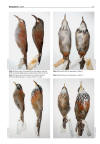 Rusty-cheeked Scimitar Babbler
Pomatorhinus erythrogenys erythrocnemis**
Gould (1862) said that
erythrocnemis
“differs conspicuously from every other known species of the genus”,
but at some stage it was lumped with
erythrogenys.
However,
P. erythrogenys
is a complex of distinctive subspecies, some of which may be species
(Rasmussen and Anderton in press). Race
erythrocnemis
differs from adjacent mainland
swinhoei
in the following: crown with blackand- grey (not brown-and-buff)
stripes; greyish (not rusty-olive) neck-sides; chin and throat pure
white; submoustachial area black (not freckled); rear ear-coverts
grey (not rusty); belly without grey tinges; mantle and scapulars
less foxy-rufous; “knees” rusty. There are probably other things;
but on this basis alone the case for upgrading
erythrocnemis
is considerable. See Plates 9 & 10. Rusty-cheeked Scimitar Babbler
Pomatorhinus erythrogenys erythrocnemis**
Gould (1862) said that
erythrocnemis
“differs conspicuously from every other known species of the genus”,
but at some stage it was lumped with
erythrogenys.
However,
P. erythrogenys
is a complex of distinctive subspecies, some of which may be species
(Rasmussen and Anderton in press). Race
erythrocnemis
differs from adjacent mainland
swinhoei
in the following: crown with blackand- grey (not brown-and-buff)
stripes; greyish (not rusty-olive) neck-sides; chin and throat pure
white; submoustachial area black (not freckled); rear ear-coverts
grey (not rusty); belly without grey tinges; mantle and scapulars
less foxy-rufous; “knees” rusty. There are probably other things;
but on this basis alone the case for upgrading
erythrocnemis
is considerable. See Plates 9 & 10.
Streak-breasted Scimitar Babbler
Pomatorhinus ruficollis musicus**
A markedly polytypic species requiring study of species limits—in
Taiwan song lower-pitched with 3–4 upturned notes all on same pitch
(Rasmussen and Anderton in press). The nearest population of
ruficollis
to Taiwan is
stridulus.
Comparison of
stridulus
and
musicus
reveals major differences, most notably in size:
musicus
is far bigger, with a relatively huge bill. Although the basic
plumage pattern is the same,
musicus
has a greyish (not olive-brown) crown, a much more distinct rufous-chestnut
nape-collar, a larger black face-mask, and blackish (not
rufouschestnut) broad streaks on the breast, with a larger white
background that better isolates these markings. Given the vocal
differences mentioned,
musicus
is a strong candidate for species-level treatment. See Plate 11 &
12.
Scaly-breasted Wren Babbler
Pnoepyga albiventer formosana*
Ingram (1909) distinguished Taiwan birds from
albiventer
by their smaller size, darker and more olivaceous back, lack of
rufous wash on wings, greater abundance of buff spotting on crown
and mantle, and purer and more extensive white below. Following a
period when
formosana
was treated as a race of
P. pusilla,
Harrap (1989) demonstrated that, if it is not specifically distinct,
formosana
belongs with
albiventer
on vocal and morphological grounds, despite the great disjunction of
their ranges. He also pointed out that the scaling extends onto the
chin in
formosana,
whereas this is white in most
albiventer.
The back of
formosana
is simply a shade darker brown, and the wings of
albiventer
do not seem to be washed rufous, but otherwise Ingram’s diagnosis
holds. Ingram and Harrap both indicated
formosana’s
size intermediacy between
albiventer
and
pusilla,
and I do not think it sufficiently distinctive to be other than a
subspecies of the former.
Rufous-capped Babbler
Stachyris ruficeps praecognita
• There are no relevant or available diagnoses to be cited here.
Race
praecognita
differs from adjacent mainland
davidi
in having slightly more pronounced and extensive throat streaking, a
slightly darker rufous cap, and slightly rufous-tinged olive
upperparts.
Streak-throated Fulvetta
Alcippe cinereiceps formosana*
There are no relevant or available diagnoses to be cited here.
Race
formosana
is closer plumage-wise to races
manipurensis
and
tonkinensis
than it is to adjacent mainland
guttaticollis.
It differs in having much the most clearly marked and extensive
throat-streaks of all, and much the strongest and most extensive
rufous wing-panel. There are other diagnostic features, but these
are the key characters.
Dusky Fulvetta
Alcippe brunnea brunnea*
There are no relevant or available diagnoses to be cited here.
Nominate
brunnea
differs from adjacent mainland
superciliaris
in being (on my eyeballing) slightly smaller, with dirty buff-grey
(not white) on throat and breast, greyer-tinged and vaguely mottled
(not plain) dull rufous crown, and darker upperparts.
Grey-cheeked Fulvetta
Alcippe morrisonia morrisonia
†
There are no relevant or available diagnoses to be cited here.
Differences between nominate
morrisonia
and adjacent mainland
hueti
are vanishingly small; sizes are similar. Possibly the lower flanks
of the nominate are a brighter buff, the long sooty superciliary
line (vague in both taxa) slightly stronger, the dull
yellowish-brown of the lower upperparts slightly less tinged rufous;
but possibly not. On this evidence
hueti
barely registers as valid, rendering
morrisonia
no longer endemic to Taiwan.
Vinous-throated Parrotbill
Paradoxornis webbianus bulomachus
• Swinhoe (1866) did not compare
bulomachus
with
webbianus
in his original description, but when he named the adjacent mainland
form
suffusus
(Swinhoe 1871) he compared it with
bulomachus,
finding
suffusus
smaller, with a smaller bill and much smaller legs and feet,
hindneck richer rufous and more definitely separated from the
greyish-olive (not rufous-washed) back. I am confused. Five birds at
random from Taiwan and five from the mainland line up rather
differently, with
bulomachus
having the brighter rufous crown and the more distinct contrast with
the yellowish-brown back, while bills, legs and feet are seemingly
the same size. On specimen after specimen the only apparent
consistent difference is in the slightly richer, brighter rufous
crown of
bulomachus.
Golden Parrotbill
Paradoxornis verreauxi morrisonianus*
There are no relevant or available diagnoses to be cited here.
Taiwan birds have a more complex facial pattern owing to the greyish
lores, sooty patch below the eye and greyish-white ear-coverts
(white lores, rest pale golden-rufous and continuous with upperparts
in
pallidus),
with a duller, slightly olive-washed back, larger black
throat-patch, olive wash to golden upper flanks.
Oriental Skylark
Alauda gulgula wattersi
‡
This taxon is judged endemic by Dickinson (2003), but
HBW
9 considers race
wolfei
of the Philippines synonymous with
wattersi.
HBW
describes this expanded
wattersi
as less rufous and more heavily streaked above than adjacent
mainland taxa, with pale rufous-buff outertail. The material in NHM
is too little to be conclusive, but it appears that three out of the
four adult birds from the Philippines have less heavily streaked
breasts than two out of the three from Taiwan. Checking against the
original description (Hachisuka 1930), however, I find (spelling and
grammar as found): “On comparing over twenty specimens from
Pescadore, Formosa and Luzon taken during the winter month,
specimens from Luzon has more heavilly maculated breast”! I think
the
HBW
solution is therefore appropriate.
Plain Flowerpecker
Dicaeum concolor uchidai
–
Similar to race
olivaceum
but tail shorter and generally darker (Cheke and Mann 2001). This is
evidently taken from Kuroda (1920), who continued: “In fact, the
upper parts are of a deep olive colour somewhat paler on rump and
upper tail-coverts; sides of breast and flanks tinged with olive
colour; tail blackish brown, faintly tinged with steel green”. There
are no specimens in NHM. Specimens of
olivaceum
correspond to the quoted sentence, suggesting that its contents are
diagnostically valueless, but quick measurements of five tails put
them all above the 23 mm given by Kuroda for
uchidae.
Fire-breasted Flowerpecker
Dicaeum ignipectum formosum
–
From nominate in being glossy steel-blue above; red below extends
onto chin (Cheke and Mann 2001). There are two adult specimens of
formosum
in NHM including the type. The above description is mistaken over
the coloration of the upperparts, which are mainly bluish-tinted
bottle-green, and in this regard like many nominate
ignipectum.
Moreover, one
ignipectum
(98.10.20.32) has redtipped yellowish chin and throat feathers, not
quite as marked as in
formosum
but meaning that this one character is rather shaky. In fact, Kuroda
(1920), reporting on seven male specimens, seemed to encounter the
same thing: “In two of the specimens the white patch [sic]
on throat shows a considerable admixture of red, while in the others
the red is much less represented”. This subspecies is, accordingly,
scarcely worth recognition; but more material is needed to decide.
Alpine Accentor
Prunella collaris fennelli –
Similar to race
nipalensis,
but has deeper, more greyish ground colour to head, neck and breast,
deeper red-brown on flanks (chestnut rather than ferruginous), and
deep ferruginous (rather than brown) uppertail-coverts (Deignan
1964). There are no specimens from Taiwan in NHM.
Black-headed Munia
Lonchura malacca formosana
‡
Cheng (1987) appeared to restrict this form to Taiwan, but it is
also stated to occur in N Luzon and certain islands to the north in
the Philippines (Dickinson
et al.
1991). Differs from adjacent Chinese mainland
deignani
by its brownish-grey upper hood and dark grey throat (not all
black), dull orange uppertail-coverts and outertail, and broad black
ventral line from mid-breast to vent; adjacent Philippine
jagori
has richer maroon rump, purplish-black hood, uneven-edged black
ventral line (Restall 1996, including reference to his
illustrations). Despite the large number of Philippine specimens in
NHM, none appears to be from N Luzon. The closest is a female from
Calauan, central Luzon (96.6.6.617). This indeed closely resembles
formosana
and, although the explanation for its brownish-grey hood may be that
it is not quite yet mature, on this basis it seems unwise to
restrict
formosana
to Taiwan.
Vinaceous Rosefinch
Carpodacus vinaceus formosanus
†
Slightly darker than nominate, with some winter males having lower
breast and belly brown (Clement 1993). I could not see the above
distinction in NHM. The original description (Ogilvie-Grant 1906 [in
which the name first applied was
incertus])
turns out to be based on the female and makes its comparison with
female Dark-rumped Rosefinch
C. edwardsi!
Comparison of both sexes of
formosanus
and nominate
vinaceus
show no quickly discernible differences, and I suspect this species
is monotypic.
Brown Bullfinch
Pyrrhula nipalensis uchidai*
Has very pale underparts, with almost white belly and white shafts
of central tail feathers (Clement 1993). I could not see the paler
underparts in
uchidae
when next to race
ricketti
from the adjacent mainland, but the broad long central lines of
white around the shaft of the central rectrices, which were
identified as the single diagnostic character of this subspecies
(Kuroda 1917), are present (although mostly hidden by the peculiar
elongate reflective uppertail-coverts of this species). Both sexes
show this character.
Grey-headed Bullfinch
Pyrrhula erythaca owstoni*
Males lack warm brown tones on underparts, being soft lavender-grey
from lower throat to belly and vent, occasionally tinted light pink
or buffishbrown on breast; flanks to undertail-coverts white; also
shows black (or blackish-blue) patch on outer median coverts, flight
feathers and tail very glossy bluish-black, and outer web of inner
tertial bright red; has very faint band surrounding black face.
Female is more gingery-brown on underparts and deeper grey on crown
and nape, with outer web of inner tertial bright yellow (Clement
1993). There is only one specimen in NHM, labelled female but with a
note by P. Leader suggesting it might be male. This is another
example, like
Brachypteryx montana goodfellowi
and
Tarsiger indicus formosanus,
of plumage feminisation in an insular form. Incidentally, the
diagnosis above appears to have a slip: Rothschild and Hartert
(1907) mentioned that no red or yellow appears in the wing of this
form, and none is present on the NHM specimen (it is, however, in
the preceding taxon).
Summing up
This short review is not, of course, a real taxonomic study and the
conclusions it reaches are merely tentative pointers based on often
inadequate samples. Nothing suggested here should be taken to have
any serious authority, and I should stress that in the “no decision
possible” category there are several subspecies whose
distinctiveness I have little cause to doubt but which are simply
unor inadequately represented in NHM. However, I hope that some of
these pointers will be taken up by field and museum workers,
gathering and using vocal evidence and scrutinising larger samples
of specimens, so that a clearer judgement of the true status of
these taxa can be made. The paragraphs below summarise the
foregoing.
Possibly full species (10)
Chinese Bamboo Partridge
Bambusicola thoracicus sonorivox,
Black-browed Barbet
Megalaima oorti nuchalis,
Island Thrush
Turdus poliocephalus niveiceps,
White-browed Shortwing
Brachypteryx montana goodfellowi,
Brownish-flanked Bush Warbler
Cettia fortipes robustipes,
White-throated Laughingthrush
Garrulax albogularis ruficeps,
Rusty Laughingthrush
Garrulax poecilorhynchus poecilorhynchus,
Hwamei
Garrulax canorus taewanus,
Rusty-cheeked Scimitar Babbler
Pomatorhinus erythrogenys erythrocnemis,
Streakbreasted Scimitar Babbler
Pomatorhinus ruficollis musicus.
[Note Whistling Green Pigeon
Treron formosae formosae
is possibly also a good species, but is not strictly endemic as it
includes the possibly racially distinct populations on the islands
north of Luzon.]
Well-marked subspecies (19)
Common Pheasant
Phasianus colchicus formosanus,
Mountain Scops Owl
Otus spilocephalus hambroecki,
Collared Owlet
Glaucidium brodiei pardalotum,
Crested Serpent Eagle
Spilornis cheela hoya,
Eurasian Jay
Garrulus glandarius taivanus,
Grey Treepie
Dendrocitta formosae formosae,
Spotted Nutcracker
Nucifraga caryocatactes owstoni,
Bronzed Drongo
Dicrurus aeneus braunianus,
Vivid Niltava
Niltava vivida vivida,
Whitebrowed Bush Robin
Tarsiger indicus formosanus,
Varied Tit
Parus varius castaneoventris,
Collared Finchbill
Spizixos semitorques cinereicapillus,
Black Bulbul
Hypsipetes leucocephalus nigerrimus,
Scaly-breasted Wren Babbler
Pnoepyga albiventer formosana,
Streak-throated Fulvetta
Alcippe cinereiceps formosana,
Dusky Fulvetta
Alcippe brunnea brunnea,
Golden Parrotbill
Paradoxornis verreauxi morrisonianus,
Brown Bullfinch
Pyrrhula nipalensis uchidai,
Grey-headed Bullfinch
Pyrrhula erythaca owstoni.
Poorly marked subspecies (24)
Barred Buttonquail
Turnix suscitator rostratus,
Grey-capped Pygmy Woodpecker
Dendrocopos canicapillus kaleensis,
White-backed Woodpecker
Dendrocopos leucotos insularis,
Grey-headed Woodpecker
Picus canus tancolo,
Grass Owl
Tyto capensis pithecops
(Eastern Grass Owl
T. longimembris pithecops),
Collared Scops Owl
Otus bakkamoena glabripes
or
O. lettia glabripes,
Tawny Owl
Strix aluco yamadae,
Savanna Nightjar
Caprimulgus affinis stictomus,
White-bellied Green Pigeon
Treron sieboldii sororius,
Crested Goshawk
Accipiter trivirgatus formosae,
Besra
Accipiter virgatus fuscipectus,
Black Drongo
Dicrurus macrocercus harterti,
Black-naped Monarch
Hypothymis azurea oberholseri,
Plumbeous Water Redstart
Rhyacornis fuliginosus affinis,
White-tailed Robin
Myiomela leucura montium,
Winter Wren
Troglodytes troglodytes taivanus,
Coal Tit
Parus ater ptilosus,
Greenbacked Tit
Parus monticolus insperatus,
Lightvented or Chinese Bulbul
Pycnonotus sinensis formosae,
Striated Prinia
Prinia crinigera striata,
Plain Prinia
Prinia inornata flavirostris,
Yellowishbellied Bush Warbler
Cettia acanthizoides concolor,
Rufous-capped Babbler
Stachyris ruficeps praecognita,
Vinous-throated Parrotbill
Paradoxornis webbianus bulomachus.
Possibly invalid taxa (11)
Brown Wood Owl
Strix leptogrammica/newarensis
caligata,
Oriental Turtle Dove
Streptopelia orientalis orii,
Spotted Dove
Streptopelia chinensis formosa,
Emerald Dove
Chalcophaps indica formosanus,
Slaty-breasted Rail
Gallirallus striatus taiwanus,
Black Kite
Milvus migrans formosanus,
Long-tailed Shrike
Lanius schach formosae,
Little Forktail
Enicurus scouleri fortis,
Crested Myna
Acridotheres cristatellus formosanus,
Grey-cheeked Fulvetta
Alcippe morrisonia morrisonia,
Vinaceous Rosefinch
Carpodacus vinaceus formosanus.
Valid but probably non-endemic subspecies (3)
Maroon Oriole
Oriolus traillii ardens,
Oriental Skylark
Alauda gulgula wattersi,
Black-headed Munia
Lonchura malacca formosana.
No decision possible at NHM (11)
House Swift
Apus nipalensis/affinis
kuntzi,
Elegant Scops Owl
Otus elegans botelensis,
Whistling Green Pigeon
Treron formosae formosae,
Black-chinned Fruit Dove
Ptilinopus leclancheri taiwanus,
Slaty-legged Crake
Rallina eurizonoides formosana,
Snowy-browed Flycatcher
Fidecula hyperythra innexa,
Brown-eared Bulbul
Ixos
[Microscelis]
amaurotis harterti,
Bright-headed Cisticola
Cisticola exilis volitans,
Plain Flowerpecker
Dicaeum concolor uchidai,
Firebreasted Flowerpecker
Dicaeum ignipectum formosum,
Alpine Accentor
Prunella collaris fennelli.
Acknowledgements
Brian Sykes did all the spadework in putting together the list of
candidate taxa for evaluation in this review, and I thank him
warmly—likewise the staff at the Natural History Museum, especially
Robert Prys-Jones, Mark Adams, Michael Walters and Alison Harding,
who were all extremely helpful and tolerant during my three-day
thrash around the collection, 10–12 November 2004. All photographs
(note the catalogue numbers in the plate captions are normally
prefixed with “BMNH”) were very kindly taken by C. N. Spottiswoode;
the copyright belongs to the Natural History Museum.
References
Baker,
K. (1997)
Warblers of Europe, Asia and North Africa.
London: Christopher Helm.
BirdLife International (2001)
Threatened birds of Asia: the BirdLife International Red Data Book.
(Third edition, part 3). Cambridge, U.K.: BirdLife International.
Brewer, D. (2001)
Wrens, dippers and thrashers.
London: Christopher Helm.
Brooke, R. K. (1971) Geographical variation in the Little Swift
Apus affinis
(Aves: Apodidae).
Durban Mus. Novit.
9: 93-103. Chantler, P. (2000)
Swifts.
Second edition. Robertsbridge, East Sussex, U.K.: Pica Press.
Cheke, R. A. & Mann, C. F. (2001)
Sunbirds.
London: Christopher Helm.
Cheng Tso-hsin (1987)
A synopsis of the avifauna of China.
Beijing: Science Press.
Cleere, N. (1998)
Nightjars: a guide to nightjars and related nightbirds.
Robertsbridge, East Sussex, U.K.: Pica Press. Clement, P. (1993)
Finches and sparrows: an identification guide.
London: Christopher Helm (A&C Black).
Collar, N. J. (2003) How many bird species are there in Asia?
Oriental Bird Club Bull.
38: 20-30.
Deignan, H. G. (1958) Two new birds from eastern Asia.
Proc. Biol. Soc. Washington
71: 161-162.
Deignan, H. G. (1964) A new race of the Alpine Accentor,
Prunella collaris,
from Formosa.
Bull. Brit. Orn. Club
84: 39-40. Dickinson, E. C., Kennedy, R. S. and Parkes, K. C. (1991)
The birds of the Philippines: an annotated check-list.
Tring, UK: British Ornithologists’ Union (Check-list 12).
Feare, C. and Craig, A. (1998)
Starlings and mynas.
London: Christopher Helm (A&C Black).
Ferguson-Lees, J. and Christie, D. A. (2001)
Raptors of the world.
London: Christopher Helm.
Gibbs, D., Barnes, E. and Cox, J. (2001)
Pigeons and doves.
Robertsbridge, East Sussex, U.K.: Pica Press.
Gould, J. (1862) Descriptions of sixteen new species of birds from
the island of Formosa, collected by Robert Swinhoe, Esq., Her
Majesty’s Vice-Consul at Formosa.
Proc. Zool. Soc. London
(1862): 280-286.
Hachisuka, M. (1930) Contributions to the birds of the Philippines.
Orn. Soc. Japan Suppl. Publ.
14.
Hachisuka, M. and Udagawa, T. (1950–1951) Contribution to the
ornithology of Formosa. Parts I and II.
Quart. J. Taiwan Mus.
3(4): 187–281, 4 (1/2): 1–180.
Harington, H. H. (1913) [New subspecies of Indian birds.]
Bull. Brit. Orn. Club
31: 109-111.
Harrap, S. (1989) Identification, vocalisations and taxonomy of
Pnoepyga
wren-babblers.
Forktail
5: 61-70.
Harrap, S. (1996)
Tits, nuthatches and treecreepers.
London: Christopher Helm (A&C Black).
Harris, T. (2000)
Shrikes and bush-shrikes.
London: Christopher Helm (A&C Black).
Hartert, E. (1909)
Tarsiger indicus formosanus
subsp. n.
Bull. Brit. Orn. Club
25: 32-33.
Hartert, E. (1910a)
Die Vögel der paläarktischen Fauna,
1. Berlin: R. Friedländer und Sohn.
Hartert, E. (1910b) The birds of Hainan.
Novit. Zool.
17: 189-254.
Hartert, E. (1912) [A new form of starling from Formosa.]
Bull. Brit. Orn. Club
31: 14.
HBW
+ number = relevant volume of
Handbook of the birds of the world,
edited by J. del Hoyo, A. Elliott and either J. Sargatal or D. A.
Christie (1992–present).
Holyoak, D. T. (2001)
Nightjars and their allies.
Oxford: Oxford University Press (Bird Families of the World 7).
Ingram, C. (1909) [A new subspecies of hill-wren (Pnoëpyga).]
Bull. Brit. Orn. Club
23: 96-97.
Johnsgard, P. A. (1991)
Bustards, hemipodes, and sandgrouse: birds of dry places.
Oxford: Oxford University Press. König, K., Weick, F. and Becking,
J.-H. (1999)
Owls.
Robertsbridge, East Sussex: Pica Press.
Kuroda, N. (1917) Notes on Formosan birds, with the description of a
new bullfinch.
Annotationes Zoologicae Japonenses
9: 255-297.
Kuroda, N. (1920) Notes on and descriptions of the flower-peckers
of Formosa.
Tori
2: 230-236.
Kuroda, N. (1922) Description of four new birds from the islands of
Japan and Formosa.
Annotationes Zoologicae Japonenses
10: 115- 118.
Kuroda, N. (1927) A list of the birds described by the author during
the years from 1915 to 1925, with descriptions of two new forms.
Ibis
(12)3: 691-723.
La Touche, J. D. D. (1931-1934)
A handbook of the birds of eastern China,
2. London: Taylor & Francis.
Lefranc, N. (1997)
Shrikes: a guide to the shrikes of the world.
Robertsbridge, East Sussex, UK: Pica Press.
Madge, S. and Burn, H. (1993)
Crows and jays.
Robertsbridge, East Sussex, UK, Helm Information.
Madge, S. and McGowan, P. (2002)
Pheasants, partridges and grouse.
London: Christopher Helm.
Mayr, E. (1949) Geographical variation in
Accipiter trivirgatus.
Amer. Mus. Novit.
1415.
Mees, G. F. (1970) Notes on some birds from the island of Formosa
(Taiwan).
Zool. Meded.
44: 285-304.
Ogilvie-Grant, W. R. (1906) [Descriptions of new species of birds…
collected in the highlands of central Formosa by Mr Walter
Goodfellow.]
Bull. Brit. Orn. Club
16: 118-123.
Rasmussen, P. C. and Anderton, J. C. (in press)
Birds of South Asia: the Ripley guide.
Barcelona: Lynx Edicions.
Restall, R. (1996)
Munias and mannikins.
Robertsbridge, East Sussex, UK: Pica Press.
Ripley, S. D. (1962) A new subspecies of Black-chinned Fruit-Dove.
Proc. Biol. Soc. Washington
75: 315-316.
Rothschild, W. and Hartert, E. (1907) [A new species of bullfinch.]
Bull. Brit. Orn. Club
21: 9-10.
Salvadori, T. (1887) Diagnosi di nuove specie di uccelli del
Tenasserim, raccolte del Sig. Leonardo Fea.
Ann. Mus. Civ. Genova
25: 514-516.
Seebohm, H. (1895) On some new and little-known species of birds
from Formosa.
Ibis
(7)1: 211-213.
Sharpe, R. B. (1879)
Catalogue of birds in the British Museum,
4. London: Trustees of the British Museum.
Short, L. L. (1982)
Woodpeckers of the world.
Greenville, Delaware: Delaware Museum of Natural History (Monogr.
Ser. 4).
Stresemann, E. (1913) Über einige Formen von
Hypothymis azurea
(Bodd.).
Novit. Zool.
20: 293-297.
Stuart Baker, E. C. (1918) Some notes on the Dicruridae.
Novit. Zool.
25: 291-304.
Stuart Baker, E. C. (1919) Some notes on Oriental woodpeckers and
barbets.
Ibis
(11)1: 181-222.
Swinhoe, R. (1863) The ornithology of Formosa, or Taiwan.
Ibis
4: 198- 219, 250-311, 377-435.
Swinhoe, R. (1864) Descriptions of four new species of Formosan
birds; with further notes on the ornithology of the island.
Ibis
5: 361-370.
Swinhoe, R. (1865) Letter to the Editor, Takow, Formosa, 1 April
1865.
Ibis
(2)1: 354-359.
Swinhoe, R. (1866) Ornithological notes from Formosa.
Ibis
(2)2: 293- 316.
Swinhoe, R. (1870) On the ornithology of Hainan.
Ibis
(2)6: 77-97, 230- 256, 342-367. Swinhoe, R. (1871) A revised
catalogue of the birds of China and its islands, with descriptions
of new species, references to former notes, and occasional remarks.
Proc. Zool. Soc. Lond.
(1871): 337- 423.
Taylor, B. (1998)
Rails: a guide to the rails, crakes, gallinules and coots of the
world.
Robertsbridge, East Sussex, UK: Pica Press.
Vaurie, C. (1955) Systematic notes on Palearctic birds. No. 15.
Turdinae: the genera
Turdus,
Grandala,
and
Enicurus.
Amer. Mus. Novit.
1733.
Winkler, H., Christie, D. A. and Nurney, D. (1995)
Woodpeckers.
Robertsbridge, East Sussex, UK: Pica Press.
Yamashina, Y. (1932)
Hypotaenidia striata taiwana,
subsp. nov., and
Streptopelia orientalis orii,
subsp. nov.
Tori
7: 414-415.
Yamashina, Y. (1936)
Strix nivicola yamadae
subsp. nov.
Tori
9: 220-221.
N. J. Collar, BirdLife International,
Wellbrook Court, Girton Road, Cambridge CB3 0NA,
and Conservation Biology Group,
Department of Zoology, Downing Street, Cambridge CB2 3EJ, U.K.
|
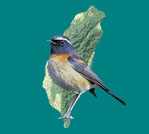

.jpg)
.jpg)

.jpg)
